
GajimaruClassics.
Viewing preferencesShown as painted
Veil paintings showing

Preferences stay on this device. Reveal a painting without changing them.

The Garden of Earthly Delights by Hieronymus Bosch

The Garden of Earthly Delights

Hieronymus Bosch · 15th century

painting

Nudity · ViolenceRead the context

Look closer

Select a detail to locate it.

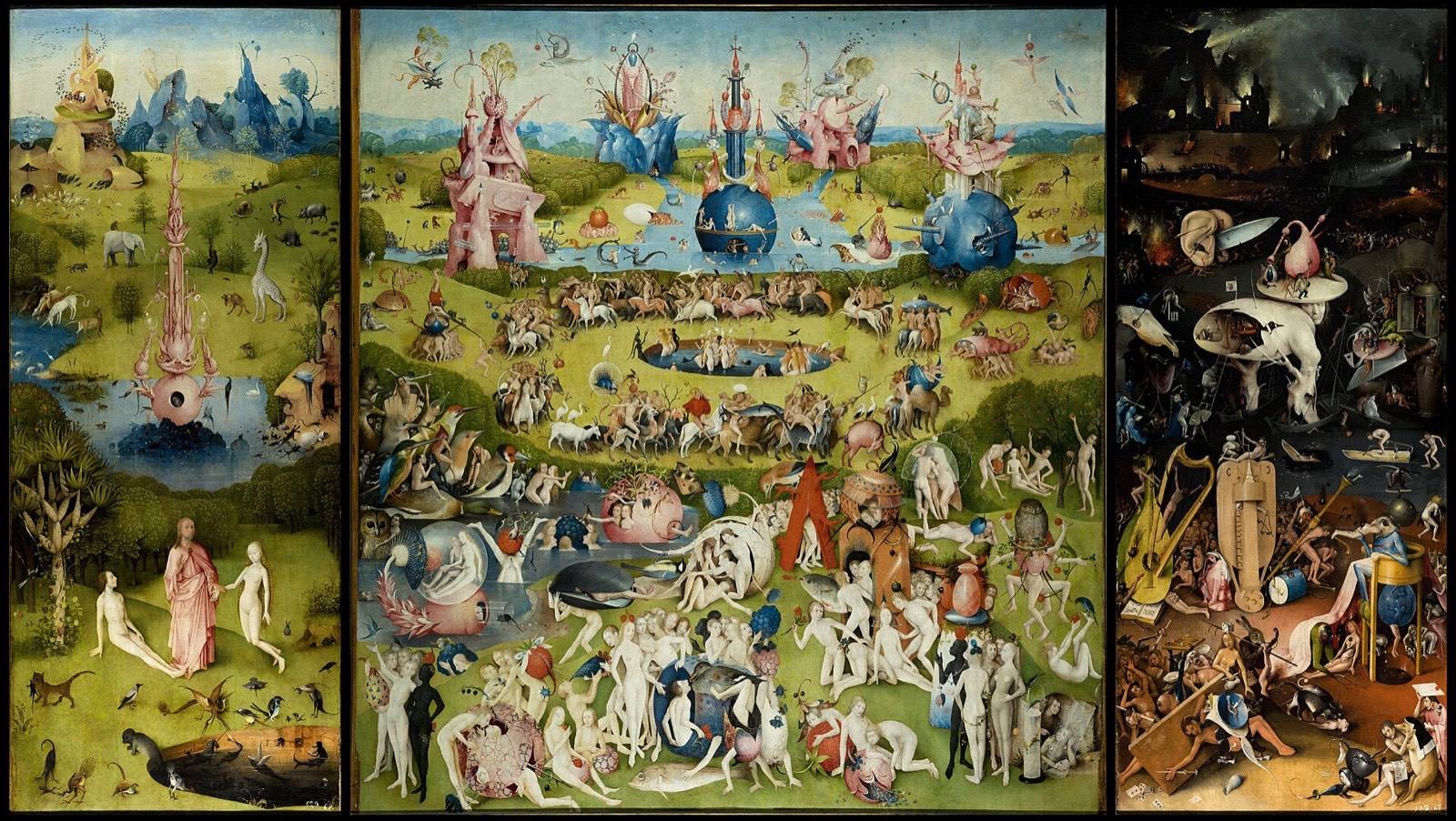
Bosch’s hinged panels open from a grey image of Creation onto a garden crowded with naked figures and fantastic animals. Eden occupies the left wing; Hell, the right. The painting’s date remains debated, with estimates ranging from around 1490 to the early 1500s.

Details

Compare the activities in the centre with the torments at the right. Bathing, eating and embracing give way to fire, ice and devils. Opening the panels changes both the palette and the world they contain.

Where it hangs

Museo del Prado

In context

A triptych read like a story

The three inner panels are meant to be read in order. Bosch shows Adam and Eve joined by God on the left, an enormous garden of earthly pleasure in the centre, and the punishment of Hell on the right, a sequence from innocence to ruin.

Nudity as biblical narrative, not display

The naked bodies filling the central panel are not portraits or erotic display in the modern sense. They stand for humanity's early innocence, embracing, bathing and eating fruit together among the animals, a scene painters of Bosch's era used to explore temptation through scripture rather than to titillate.

Hell as everyday nightmare

On the right wing, Bosch paints Hell not as an abstract underworld but as a nightmarish scene, fire and ice, monstrous devils and tormented souls, rendered with the same precision he gave the garden.

A closed world in grey

Folded shut, the triptych shows a wholly different picture, the Creation of the World painted in grisaille, a limited grey-green palette with no colour at all, so the riot of colour inside comes as a surprise when the wings open.

A disputed date

No document records when Bosch painted it. Estimates place it around 1490, in his middle years, though some historians argue the panel dates from the early 1500s instead.

The story

  1. The closed wings show Creation in grey, without the colour of the scenes inside.

  2. The left wing opens on Eden, where God presents Eve to Adam.

  3. In the central garden, naked figures embrace, bathe and eat among animals both real and fantastic.

  4. The right wing shows Hell, where fire, ice and devils torment souls.

  5. The date remains debated, with estimates ranging from around 1490 to the early 1500s. The triptych belongs to the Prado.

A way of seeing

Grisaille

Painting the closed wings in grisaille, tones of grey with no colour, was an Early Netherlandish convention, and it made the riot of colour inside the triptych land as a revelation the moment the doors opened.