
GajimaruClassics.
Viewing preferencesShown as painted
Veil paintings showing

Preferences stay on this device. Reveal a painting without changing them.

The Kiss by Gustav Klimt

The Kiss

Gustav Klimt · 1907

painting

Look closer

Select a detail to locate it.

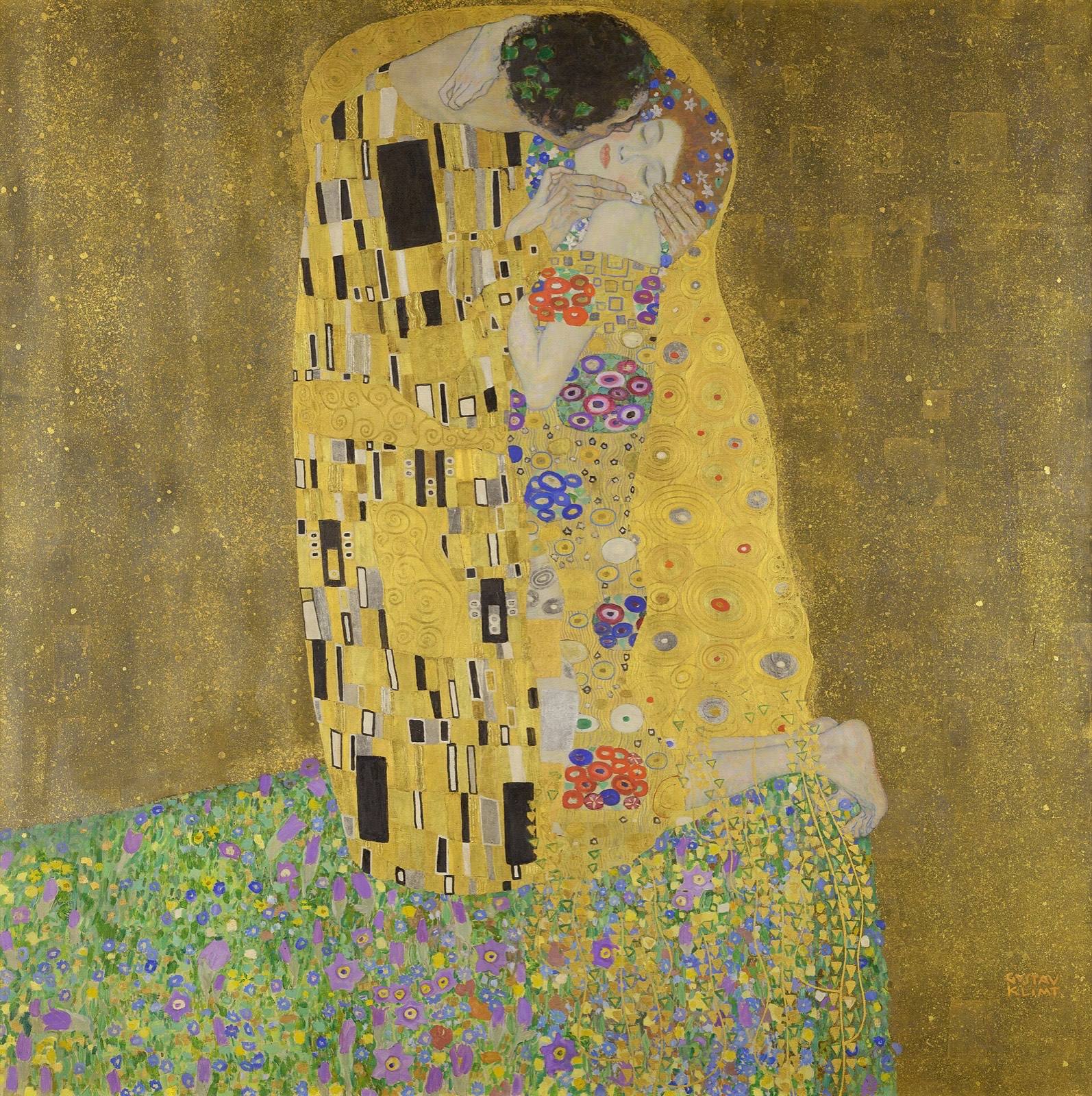
Klimt’s embracing couple kneel at the edge of a flowering meadow. Gold, silver and platinum leaf enter the painted surface. Shown in Vienna in 1908 as The Lovers, the canvas was bought by the Austrian state before it was finished.

Details

The robes distinguish the figures: geometric blocks on his, circles and flowers on hers. Their bodies meet within a shared shimmering outline. The woman’s identification as Emilie Flöge remains a theory, rather than an established portrait identity.

In its time

1907

Paintings from this period
Where it hangs

Belvedere

In context

The height of the Golden Period

Klimt painted it at the height of what is called his Golden Period, laying real gold, silver and platinum leaf over oil paint on canvas. Patterns set the two figures apart, geometric shapes on the man's robe against flowers and circles on the woman's, inside a shimmering halo.

An embrace in gold

The couple kneel at the edge of a flowering meadow. Their bodies join within a single gold form, with the robes’ patterns preserving their distinction.

An unconfirmed identity

Emilie Flöge has been proposed as the woman’s identity. This remains a theory; the face should not be treated as an established portrait of her.

Reception

Bought before completion

The Austrian state bought the unfinished painting at the Kunstschau in Vienna in 1908. Exhibited as The Lovers, it appeared as Der Kuss in the museum catalogue the following year.

The story

  1. 1907. Klimt probably begins the painting, at the height of his Golden Period.

  2. 1908. He shows it at the Kunstschau in Vienna, still unfinished and still called Liebespaar, The Lovers. The Austrian state buys it on the spot.

  3. 1909. The museum catalogue uses the title Der Kuss, The Kiss.

  4. It hangs today in the Belvedere in Vienna.

A way of seeing

The Golden Period

Klimt’s Golden Period incorporates metal leaf into painting. Here gold, silver and platinum contribute to a surface organised by ornamental pattern.