
GajimaruClassics.
Viewing preferencesShown as painted
Veil paintings showing

Preferences stay on this device. Reveal a painting without changing them.

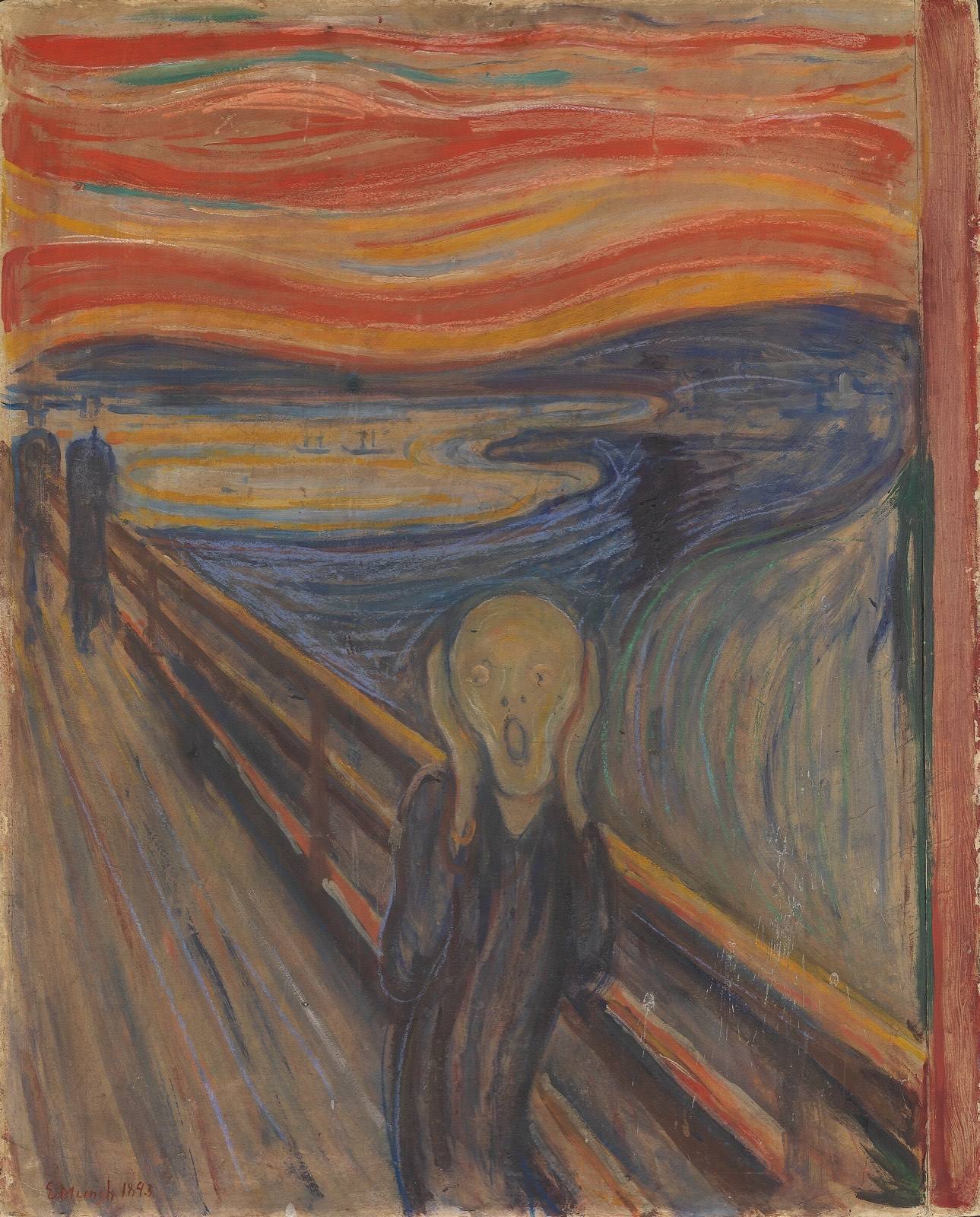
The Scream by Edvard Munch

The Scream

Edvard Munch · 1893

group of paintings

Look closer

Select a detail to locate it.

Where it hangs

National Gallery of Norway

In his notebook, Munch described a sunset walk by the Oslofjord and a scream passing through nature. The first painted version followed in 1893 as part of The Frieze of Life. Figure and landscape share a rhythm of distress.

Details

Follow the red sky’s curves into the figure below. Its identity and gender remain hard to fix. Two companions continue along the road behind it, while the foreground figure has stopped.

In context

A real place, remembered

Munch set the picture on an actual path above Oslo: a road on Ekeberg hill, looking over the Oslofjord and the city then called Kristiania. He had written the moment down in his own notebook before he ever painted it, walking there at sunset as the sky suddenly turned blood red.

From symbolism to expressionism

The Scream marks the hinge between two movements: the symbolism Munch had worked in through the early 1890s, and the expressionism that would define the new century. He fused form and content so completely that the same rhythm runs through both the screaming figure and the landscape around it.

A face without a name

Munch made the central figure deliberately hard to read: even its gender is unclear, and it has been described as a strange, skeletal presence rather than an ordinary face. Behind it, two friends walk on along the road while the figure alone has stopped.

One image, four versions

Munch made four versions of the composition in all: two paintings and two pastels. In 1895 he also cut the image into a black-and-white lithograph, and prints pulled from that stone survive today.

Stolen, and returned

In February 1994, thieves stole this version of The Scream from its Oslo museum, but it was recovered and returned to the museum later that same year.

The story

  1. Before he painted it, Munch set the moment down in his notebook: walking at sunset by the Oslofjord, tired, he paused and leaned on a fence as the sky suddenly turned blood red, and he sensed a scream passing through nature.

  2. 1893. Working between Berlin and Åsgårdstrand, Munch painted the first version of The Scream, part of his series The Frieze of Life.

  3. Munch kept returning to the image, eventually making four versions in paint and pastel, and in 1895 he cut it into a black-and-white lithograph whose prints still survive.

  4. 1994. In February, thieves stole this version from its Oslo museum; it was recovered and returned within the year.

  5. The figure’s expression became widely associated with anxiety and existential dread.

A way of seeing

Expressionism

Expressionism paints a feeling rather than a view: colour, line, even the landscape itself, are shaped to match an emotion rather than to record how a scene actually looked. The Scream marks this turn, fusing the screaming figure and the sky around it into a single rhythm of feeling.