


A legendary king of Assyria
Sardanapalus was a legendary king of Assyria. Delacroix based the scene on Lord Byron's 1821 play Sardanapalus.
 GajimaruClassics.
Preferences stay on this device. Reveal a painting without changing them.
Eugène Delacroix · 1827
painting
Nudity · Violence · DeathRead the context
Select a detail to locate it.
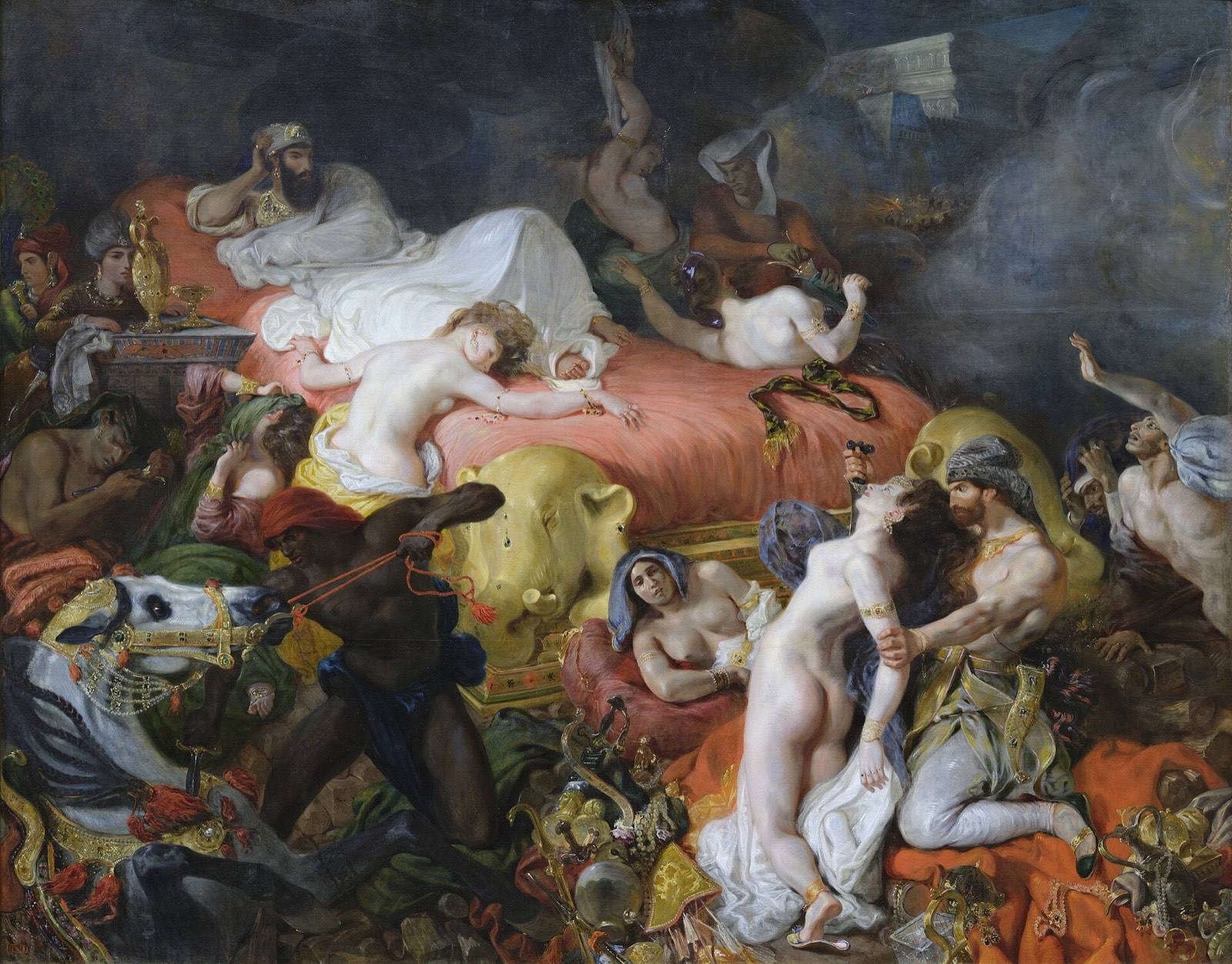
The legendary Assyrian king Sardanapalus orders the killing of those who served his pleasure, including his wives and animals. Delacroix developed the subject from Byron’s play and exhibited the painting at the Salon of 1828. The violence is commanded by the reclining figure who watches it.
Locate the king before following the killings around his bed. His detachment gives the crowded scene its governing relationship: he issues the order while others carry it out. The canvas is nearly four metres high and five wide.
1827
Musée du Louvre
Room 700
Sardanapalus was a legendary king of Assyria. Delacroix based the scene on Lord Byron's 1821 play Sardanapalus.
Sardanapalus orders his eunuchs and officers to kill his wives, his pages and even his favourite horses and dogs, so that nothing that had served his pleasure would survive him. He gives the order from where he lies on his bed and watches as his officers carry out the killing.
Delacroix finished the painting in 1827 and showed it at the Paris Salon, which opened in February 1828.
The picture belongs to Romanticism, the movement that prized feeling and imagination over the calm restraint of earlier French painting. Delacroix took the subject from Byron's play about the legendary Assyrian king.
The canvas is huge, almost four metres high and nearly five wide. It hangs today in the Louvre's Department of Paintings in Paris.
1821. Lord Byron writes his play Sardanapalus, the source for the scene.
1827. Delacroix paints The Death of Sardanapalus, in which the king orders his wives, pages, horses and dogs killed so that nothing outlives him.
1828. The painting is shown at the Paris Salon, which opens in February.
Today it hangs in the Louvre's Department of Paintings, among the museum's Romantic paintings.
Delacroix painted this scene from Byron's play about a legendary Assyrian king. Romanticism, the movement this picture belongs to, prized that kind of feeling and imagination in painting.