
GajimaruClassics.
Viewing preferencesShown as painted
Veil paintings showing

Preferences stay on this device. Reveal a painting without changing them.

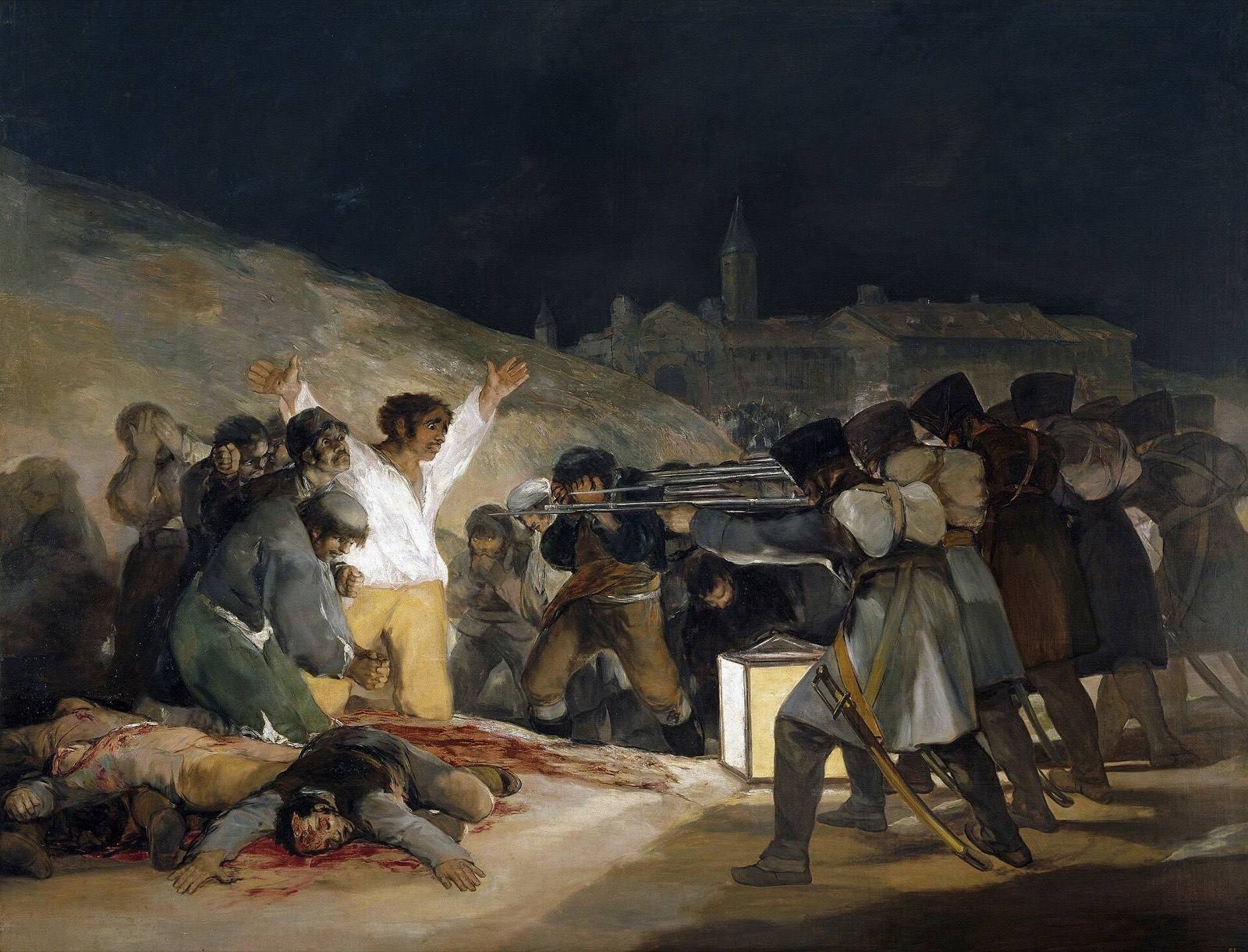
The Third of May 1808 by Francisco Goya

The Third of May 1808

Francisco Goya · 1814

painting

Violence · DeathRead the context

Look closer

Select a detail to locate it.

Goya painted the executions that followed Madrid’s uprising against French occupation in May 1808. He proposed the subject to the restored government in 1814, alongside a canvas of the uprising itself. This picture shows the reprisal, six years after the event.

Details

A lantern lights the condemned man’s open arms. Facing him, the soldiers form an anonymous line; the dead lie below. The spread arms recall a crucifixion, bringing a familiar sacred pose into a scene of political killing.

In its time

1814

Paintings from this period
Where it hangs

Museo del Prado

In context

Two days in May

Napoleon had forced the Spanish crown to abdicate in favour of his own brother, Joseph Bonaparte, and on 2 May 1808 the people of Madrid rose up against the French occupation. Marshal Joachim Murat commanded the French forces in the city, and before dawn the next morning hundreds of Spaniards were rounded up and shot at sites around Madrid.

A picture with a twin

Goya painted it as a companion to The Second of May 1808, which shows the fighting at the Puerta del Sol, Madrid's central square. Together the two canvases carry the fury of the rising and the silence of its punishment.

No heroes, no villains

Goya named no one. The condemned and the soldiers who shoot them are painted as ordinary, anonymous people, and the picture uses no symbol or allegory to soften what is happening. The firing squad is shown from behind, a uniform line of identical men aiming their rifles.

A pose like Christ's

The man at the centre is lit brighter than anyone else, and he throws his arms wide in defiance or appeal. Viewers have long set his pose beside images of the crucified Christ.

Kept out of sight

The government paid Goya for the two paintings, but the Spanish monarchy chose not to put them on public view. The Third of May was kept out of sight for a long time after it was painted.

The story

  1. 1808. Napoleon forced the Spanish crown to abdicate in favour of his own brother, Joseph Bonaparte, and on 2 May the people of Madrid rose up against the French occupation.

  2. The next morning Marshal Joachim Murat's forces rounded up hundreds of Spaniards who had taken up arms and shot them at sites around Madrid.

  3. 1814. With the French driven out, Goya proposed to the restored government that he paint the rising and its aftermath, as a companion to The Second of May 1808.

  4. The government paid him, but the painting was kept out of public view for a long time afterwards.

A way of seeing

Chiaroscuro

Goya lights the whole scene with one lantern against total darkness, so the man it catches brightest becomes the one the eye cannot avoid. That trick of strong light against deep shadow is called chiaroscuro.