

At the Wallace Collection
The portrait belongs to the Wallace Collection in London. Its elaborate costume and vivid handling are central to Hals’s treatment of the sitter.
 GajimaruClassics.
Preferences stay on this device. Reveal a painting without changing them.
Frans Hals · 1624
painting
Select a detail to locate it.
1624
Wallace Collection
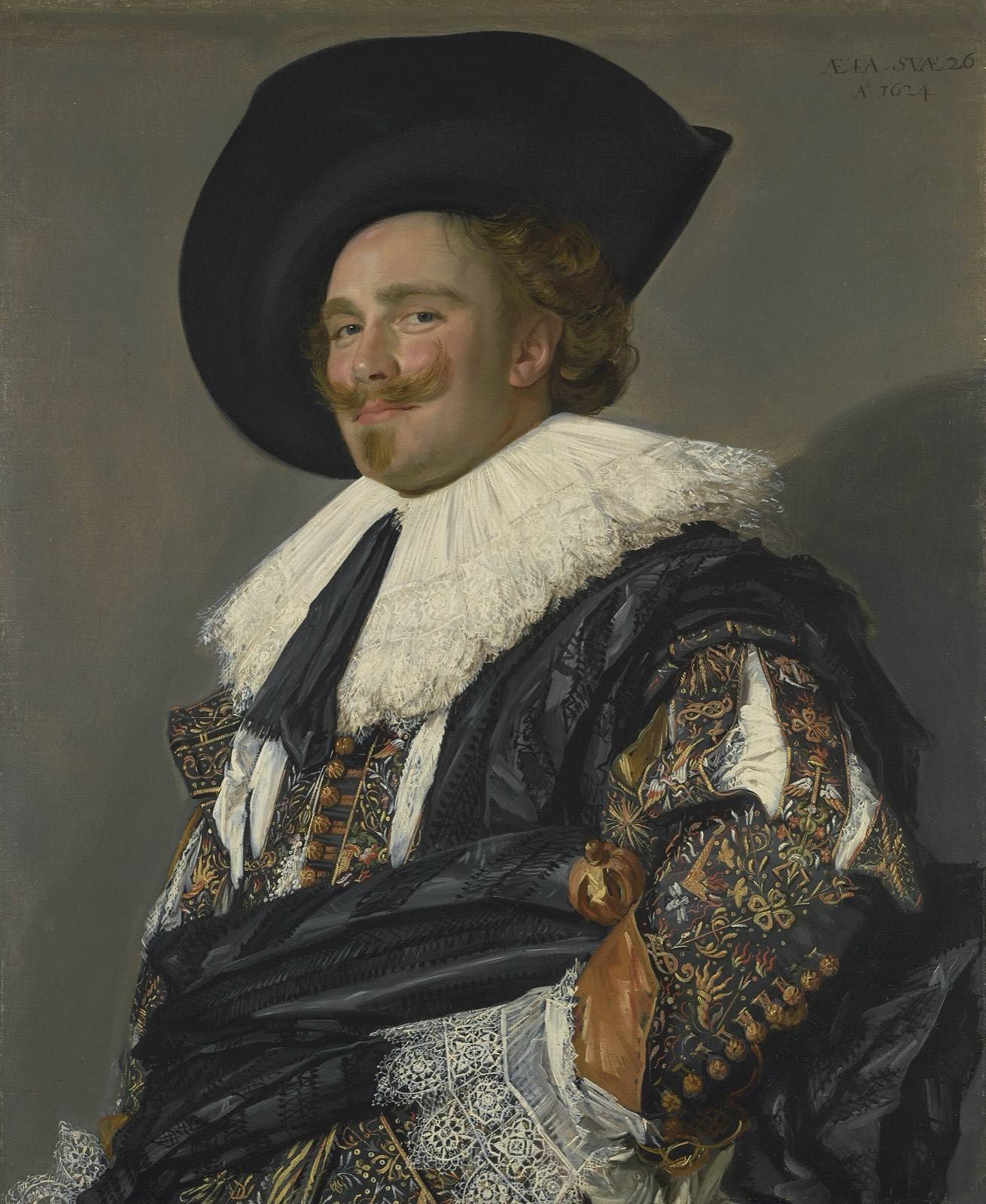
The sitter is twenty-six, but his identity remains unknown. Neither the laugh nor the military identity suggested by the title is secure. Hals gives him a richly embroidered doublet carrying emblems associated with love.
Compare the half-smile with the elaborate costume. What appears painstakingly described emerges from quick, confident brushstrokes. The handling of the fabric helps give the portrait its vivid presence.
The portrait belongs to the Wallace Collection in London. Its elaborate costume and vivid handling are central to Hals’s treatment of the sitter.
His doublet is embroidered with symbolic emblems, love chief among them, set off by fine, expensive silk. Hals painted it with striking skill: elaborate in appearance, but done in quick, confident brushwork.
Victorian audiences and the press supplied the familiar nickname long after Hals painted the portrait.
The expression is a half-smile rather than a laugh. The later title exaggerates what the face shows.
Nobody knows who he really was. He may have been a wealthy civilian rather than a soldier, whatever the nickname implies.
Hals paints an unknown sitter at twenty-six, giving him a spontaneous, confident presence and a doublet embroidered with emblems of love.
Victorian audiences and the press give the portrait its catchy nickname, though the sitter is not laughing and nobody knows who he really was.
The portrait belongs to the Wallace Collection in London, where its later nickname remains familiar.
A misnomer is a misleading name. Victorian audiences supplied this title; neither a literal laugh nor the sitter’s identity as a soldier is established.