

Shepherds at a tomb
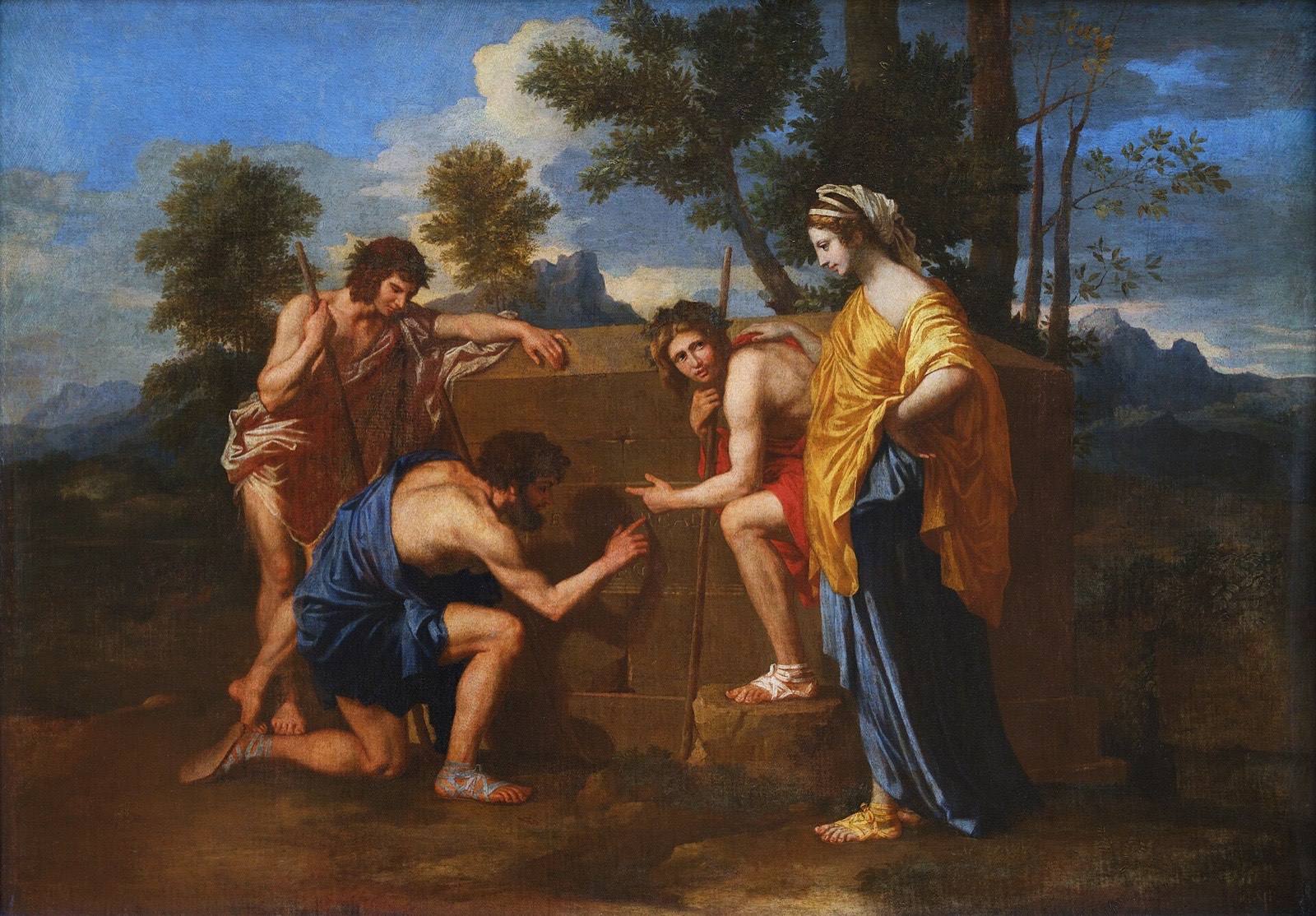
Shepherds, and a woman who may be a shepherdess, gather at an austere tomb in Arcadia. Cut into its stone are words they bend to read: Et in Arcadia ego.
 GajimaruClassics.
Preferences stay on this device. Reveal a painting without changing them.
Nicolas Poussin · 1638
painting
Select a detail to locate it.
Shepherds gather at a tomb to read Et in Arcadia ego. Poussin had painted this subject before, following an earlier treatment by Guercino. This version, dated around 1637–38, gives the discovery a quieter, more ordered composition.
Read the inscription with its competing interpretations. Bellori heard Death speaking even in Arcadia; Félibien heard the person buried there recalling a former life. The figures’ calm attention leaves room for both readings.
1638
Musée du Louvre
Room 825
Shepherds, and a woman who may be a shepherdess, gather at an austere tomb in Arcadia. Cut into its stone are words they bend to read: Et in Arcadia ego.
Poussin's early biographers disagreed on who speaks. Bellori heard Death itself, warning that even Arcadia is no refuge. Félibien heard the person buried there, remembering a life once lived.
A memento mori reminds the viewer of death, most often through a skull. Poussin leaves the skull out here, and the mood turns from shock to quiet, geometric calm.
An earlier painter, Guercino, had already painted shepherds finding a skull on broken stone marked with the same words, around 1618. Poussin himself had painted the subject once before, too, in a version now at Chatsworth House.
Poussin, born near Les Andelys in 1594, painted it in the second quarter of the seventeenth century, around 1637 to 1638. It hangs today in the Musée du Louvre, in Paris.
Around 1618, an earlier painter, Guercino, paints shepherds finding a skull on broken stone marked with the same words.
Poussin himself paints the subject once before, in a version now at Chatsworth House.
Around 1637 to 1638, Poussin paints this quieter version. The skull is gone, and the mood turns to quiet, geometric calm.
His early biographers read the stone two ways: Bellori heard Death's own warning, Félibien heard the dead themselves remembering.
It hangs today in the Musée du Louvre, in Paris.
A memento mori reminds the viewer of death, most often through a skull. Poussin's own early biographer called this very painting one, even though he leaves the skull out and lets quiet, geometric calm carry the thought instead.