

A Sunday on the island
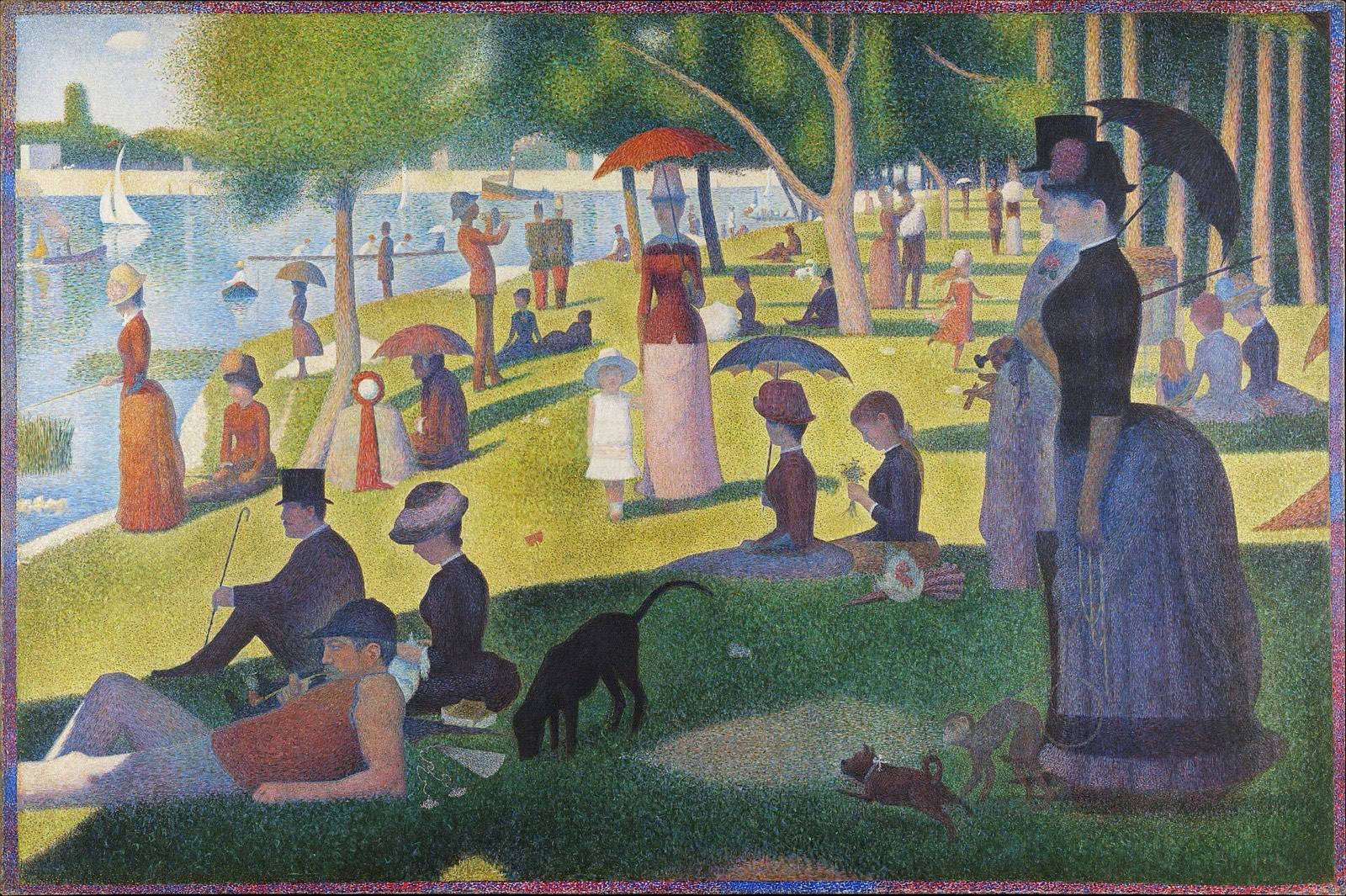
It is Seurat's best known painting: Parisians at leisure in a park on the Seine, at the island called La Grande Jatte.
 GajimaruClassics.
Preferences stay on this device. Reveal a painting without changing them.
Georges Seurat · 1884
painting
Select a detail to locate it.
Seurat’s Parisians spend an afternoon beside the Seine on La Grande Jatte. He began the canvas in 1884 and revised it across several campaigns before its public debut in 1886. The apparent leisure rests on sustained work.
At close range the surface separates into dots of colour. Seurat drew on optical theory, placing colours side by side for the eye to combine. He later added a dotted border to mediate between the painting and its white frame.
1884
Art Institute of Chicago
It is Seurat's best known painting: Parisians at leisure in a park on the Seine, at the island called La Grande Jatte.
Seurat began the canvas in 1884, then kept coming back to it, working in campaigns across nearly two years. He revised his figures as he went and refined his palette.
Rather than mix paint on the palette, Seurat set down tiny dots of pure colour side by side, a technique known as Pointillism or Divisionism. He grounded it in optical and colour theory: dots the eye would mix into a single, brighter hue.
In 1889, Seurat restretched the canvas and ringed the scene with a painted border of dots. It formed a transition into his own specially designed white frame.
1884. Seurat begins the canvas.
1885 to 1886. He keeps returning to it, working in campaigns, revising figures and refining his palette.
1886. The canvas makes its public debut.
1889. Seurat adds a painted border of dots at the edge.
Instead of mixing paint on the palette, Seurat set down pure colour in tiny dots and let the eye blend them into a single, brighter hue: a technique called Pointillism or Divisionism, grounded in the new science of optics.