Friend of the People
L'Ami du Peuple, Marat's own radical newspaper, gave him his nickname. In 1793 Charlotte Corday stabbed him to death in his bath.
 GajimaruClassics.
Preferences stay on this device. Reveal a painting without changing them.
Jacques-Louis David · 1793
painting
DeathRead the context
Select a detail to locate it.
1793
Royal Museums of Fine Arts of Belgium
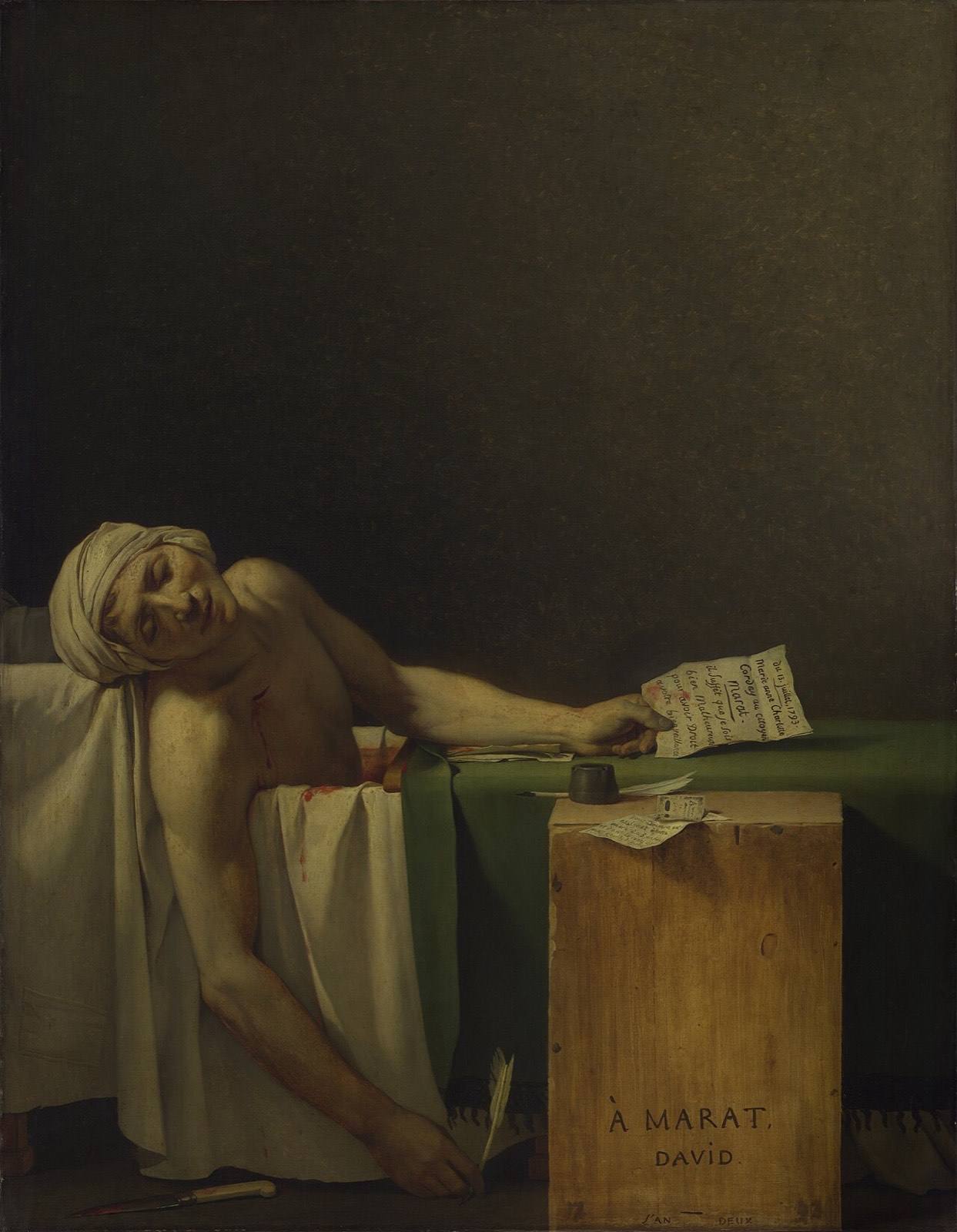
Marat still holds the note Charlotte Corday used to gain access to him. David painted the murdered revolutionary journalist in 1793, giving the dead man the calm light and pose of a Christian martyr.
Follow the hanging arm from the softly lit face to the note. The bloodied knife on the floor returns the scene to the violence of the killing. The pose’s resemblance to a Pietà gives that violence a religious visual language.
L'Ami du Peuple, Marat's own radical newspaper, gave him his nickname. In 1793 Charlotte Corday stabbed him to death in his bath.
David painted Marat's death the way earlier painters painted the dead Christ, the light falling gently on his face and one arm hanging loose, in a pose viewers recognised from the Pietà. It was David's way of giving a murdered revolutionary the solemnity once kept for saints.
In his left hand, hanging over the tub's edge, David painted the note Corday sent asking to see him. Below it, on the floor, lies the knife that killed him, and the wound it made is still open on his chest.
Marat ran the radical newspaper L'Ami du Peuple, Friend of the People.
1793. Charlotte Corday stabs him to death in his bath.
He still holds the note she sent asking to see him.
The knife falls to the floor, and the wound it made stays open on his chest.
David paints him with the calm face and loose arm of a Pietà, giving a revolutionary the weight of a martyr.
A Pietà usually shows the Virgin Mary cradling the dead Christ, his arm hanging loose, his face lit and calm. David borrowed that same light and pose for a revolutionary stabbed in his bath, so viewers already knew how solemnly to look at him.