
GajimaruClassics.
Viewing preferencesShown as painted
Veil paintings showing

Preferences stay on this device. Reveal a painting without changing them.

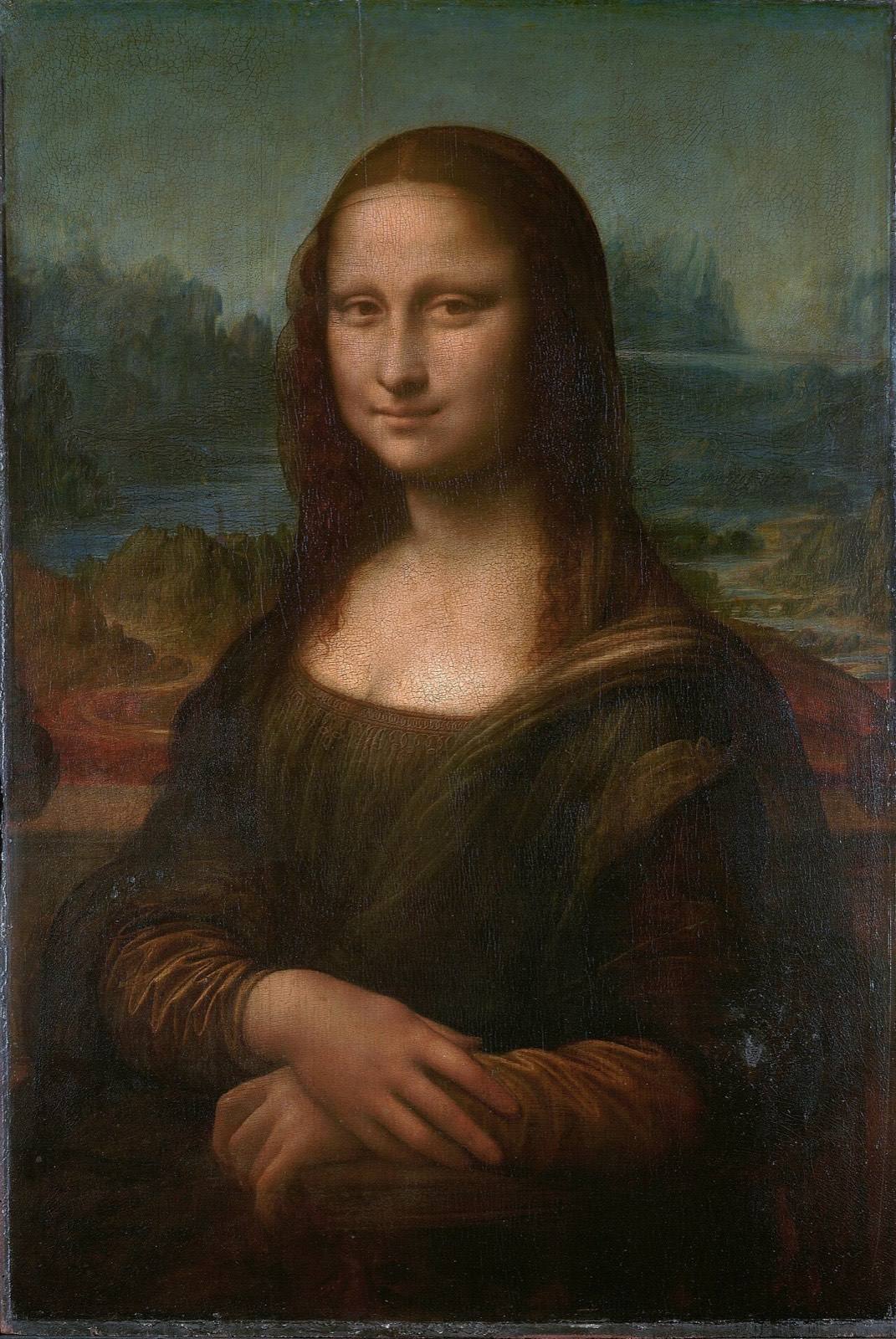
Mona Lisa by Leonardo da Vinci

Mona Lisa

Leonardo da Vinci · 1500s

painting

Look closer

Select a detail to locate it.

In its time

1500s

Paintings from this period
Where it hangs

Musée du Louvre

Salle des États, Louvre

Leonardo’s portrait of Lisa del Giocondo is painted on poplar. A contemporary note dated October 1503 records him at work on it. Vasari later wrote that Lisa’s husband, Francesco, commissioned the portrait.

Details

The transitions around the mouth and eyes soften through sfumato, thin layers that dissolve hard edges. Behind her, distant mountains fade in aerial perspective. Figure and landscape share the same gradual movement from clarity into haze.

In context

Monna Lisa, La Gioconda

In 2005 a scholar at Heidelberg University found a note dated October 1503, written by Leonardo's contemporary Agostino Vespucci: proof Leonardo was already painting Lisa del Giocondo that autumn. Vasari later named her husband, silk merchant Francesco del Giocondo, as the one who commissioned it; Italians called her Monna Lisa, short for Madonna Lisa, and La Gioconda after his surname.

A portrait never delivered

Leonardo retained the portrait and brought it to France in 1516. It later entered the French royal collection, passing through Fontainebleau and Versailles.

Sfumato and a vanishing smile

Leonardo modelled the face in sfumato, translucent glazes that dissolve every hard edge between light and shadow. It softens the corners of her mouth and eyes just enough that her expression seems to change as your eyes move, which is why Vasari called the smile 'more divine than human.'

An imagined world behind her

Mountains and rivers fade behind the sitter in aerial perspective. The turned pose and open landscape differ from the strict profile and plain background used in earlier portraits.

The theft of 1911

Vincenzo Peruggia stole the painting from the Louvre in 1911. Recovered in Florence in 1913, it returned after extensive international coverage of its disappearance.

The story

  1. 1503. In October, a note in the margin of an old book shows Leonardo already painting Lisa del Giocondo, wife of a Florentine silk merchant.

  2. 1516. Leonardo brings the portrait to France.

  3. 1519. Leonardo dies at Amboise; the portrait was never delivered to the Giocondo family.

  4. 1797. After the Revolution, the Mona Lisa goes on permanent public display in the Louvre's Department of Paintings.

  5. 1911. Vincenzo Peruggia steals the painting from the Louvre.

  6. 1913. The painting is recovered in Florence and returned to the Louvre.

A way of seeing

Sfumato

Sfumato means smoky in Italian. Instead of hard outlines, Leonardo built form from translucent layers that blur where light meets shadow, which is why the Mona Lisa's expression seems to shift the longer you look.

More by Leonardo da Vinci