
GajimaruClassics.
Viewing preferencesShown as painted
Veil paintings showing

Preferences stay on this device. Reveal a painting without changing them.

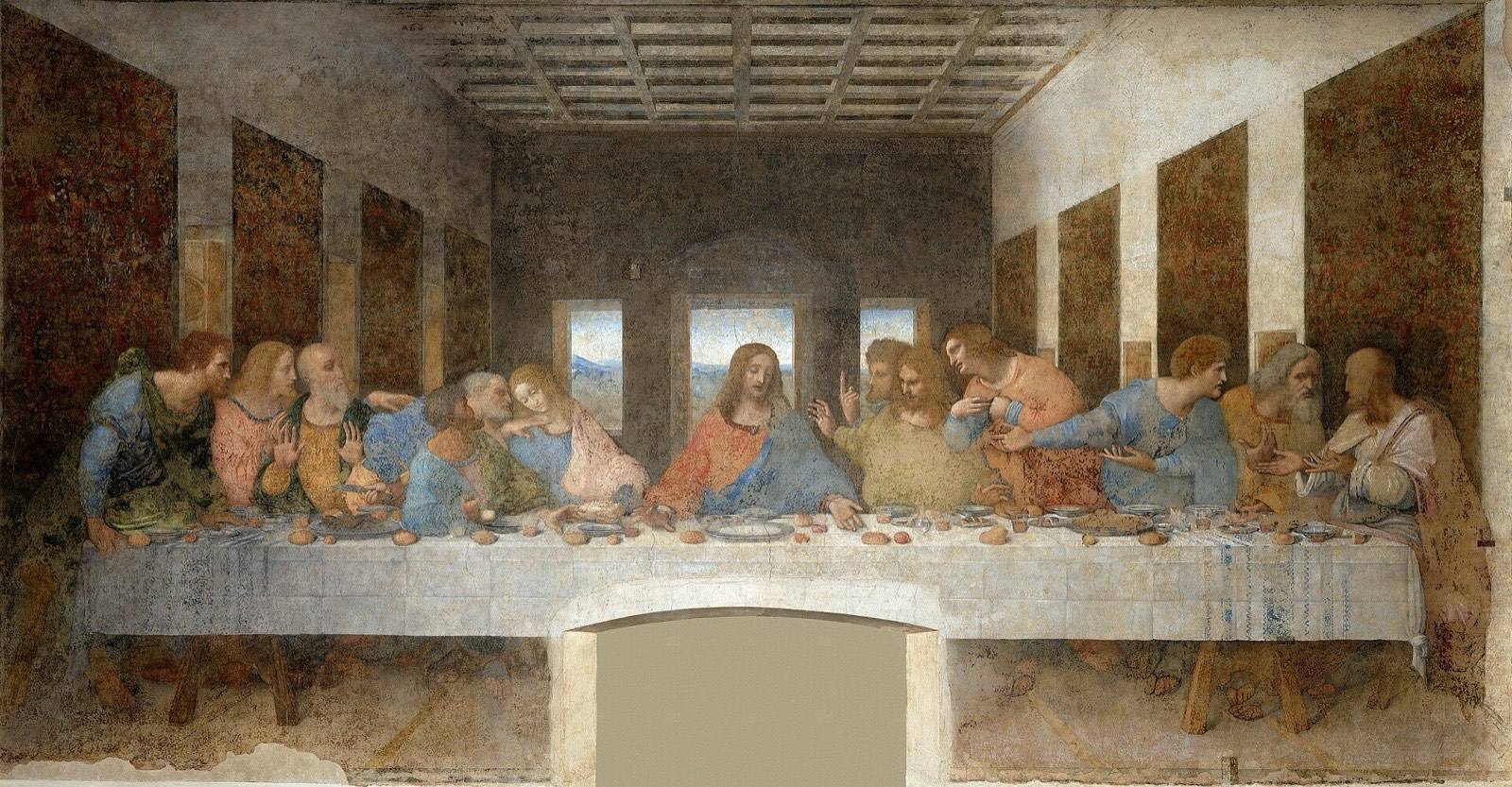
The Last Supper by Leonardo da Vinci

The Last Supper

Leonardo da Vinci · 1490s

wall painting

Look closer

Select a detail to locate it.

Christ has announced that one of the Twelve Apostles will betray him. Leonardo painted their responses on the dining-hall wall of Santa Maria delle Grazie in Milan. His preparatory notes planned individual gestures before he painted the group.

Details

Follow the exchange between Peter and John, then Judas’s backward movement into shadow. The reactions make each figure distinct within the gathering. Leonardo’s notes preserve the attention he gave to listening, turning and the movement of hands.

In its time

1490s

Paintings from this period
Where it hangs

Santa Maria delle Grazie

In context

Notes before a single figure

Years before he lifted a brush, Leonardo planned the apostles' reactions on paper: one who had been drinking turns his head towards the speaker, another twists his fingers together with stern brows. The finished wall keeps that same restless individuality in every hand and face.

The group around Judas

Leonardo's notes for this trio describe one figure leaning in to whisper, another turning with a knife; in the finished picture it is Peter, John and Judas. Judas leans back into shadow, tipping the salt cellar as he reaches for bread, while John tilts toward Peter to hear who the betrayer is.

Naming the twelve

Leonardo's own studies name the disciples individually: one note places Matthew as the fourth figure on Christ's left hand, and a drawing lists Philip, Simon, Matthew, Thomas, James the Greater and Peter by name, each given a distinct face and gesture.

Famous through its copies

No other picture of the Renaissance became so well known, copied by other hands again and again. An editor of Leonardo's notebooks called it one of the two grandest compositions he ever executed, alongside the lost Battle of Anghiari; it remains his largest surviving painted work after the Sala delle Asse.

A wall too fragile

Leonardo used an experimental technique on a thin, damp exterior wall, and it did not last: by 1517 the paint was already flaking. Restorations followed for centuries afterwards, some of them reckless, each one changing the wall a little more.

The story

  1. Leonardo drafts the apostles' reactions on paper years before he paints a single figure: one turns to listen, another twists his fingers together with stern brows.

  2. He paints the scene onto an end wall of the dining hall at the Dominican convent of Santa Maria delle Grazie in Milan.

  3. 1517. Barely two decades on, the wall is already flaking, its experimental technique too fragile for a damp exterior wall.

  4. The centuries that follow bring more restorations, some of them reckless, layered one on top of another.

  5. Even so, no other picture of the Renaissance becomes so well known, copied again and again by other hands long after the original began to fade.

A way of seeing

Compositional study

Before painting a single figure, Leonardo worked out each apostle's reaction on paper: one turns to listen, another twists his fingers together with stern brows. Even the most spontaneous-looking painting was planned gesture by gesture long before any paint touched the wall.

More by Leonardo da Vinci