For an altar in Piacenza
Pope Julius II commissioned it as an altarpiece for the high altar of the monastery church of San Sisto in Piacenza. The commission required it to show Saint Sixtus and Saint Barbara, the two saints venerated at that altar.
 GajimaruClassics.
Preferences stay on this device. Reveal a painting without changing them.
Raphael · 1510s
painting
Select a detail to locate it.
1510s
Gemäldegalerie Alte Meister
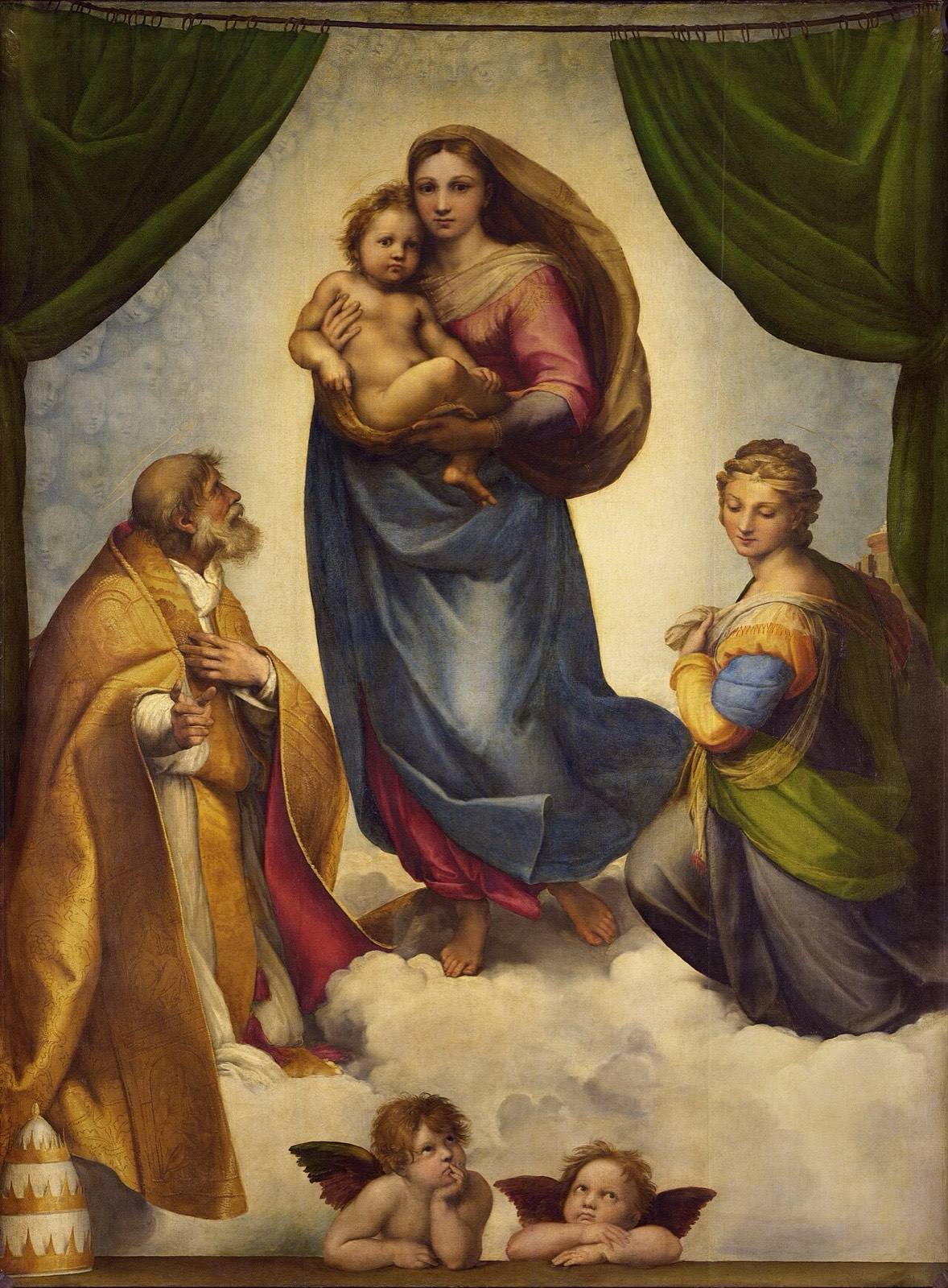
Raphael painted this altarpiece for San Sisto in Piacenza at Pope Julius II’s commission. Curtains reveal the Madonna and Child on clouds between Saint Sixtus and Saint Barbara. The painting travelled to Dresden in 1754.
Follow the parted curtains down through the central figures to the two small angels resting on the lower ledge. The scene places the heavenly appearance above figures who lean at the picture’s threshold.
Artist Raphael Collection Gemäldegalerie Alte Meister, Dresden
Pope Julius II commissioned it as an altarpiece for the high altar of the monastery church of San Sisto in Piacenza. The commission required it to show Saint Sixtus and Saint Barbara, the two saints venerated at that altar.
Curtains part to reveal the Madonna, holding the Christ Child, as she stands on clouds between Saint Sixtus and Saint Barbara. It reads as a vision from another world.
Two winged angels rest their elbows on a ledge at the bottom of the painting. They sit just below where the Madonna and the two saints stand.
In 1754 the painting left Piacenza for Dresden, acquired for Augustus III, elector of Saxony and king of Poland. After the Second World War, Soviet forces took it to Moscow, and it only returned to Dresden in 1956.
The altarpiece belongs to the Gemäldegalerie Alte Meister in Dresden.
Raphael paints it for Pope Julius II, for the high altar of the monastery church of San Sisto in Piacenza.
1754. It leaves Piacenza for Dresden, acquired for Augustus III, elector of Saxony and king of Poland.
After the Second World War, Soviet forces carry it to Moscow.
1956. It returns to Dresden, to the Gemäldegalerie Alte Meister, where it still hangs.
Raphael’s altarpiece belongs to the High Renaissance. The parted curtains reveal a centrally arranged Madonna and Child, balanced by the two saints.