
Arrival, not birth
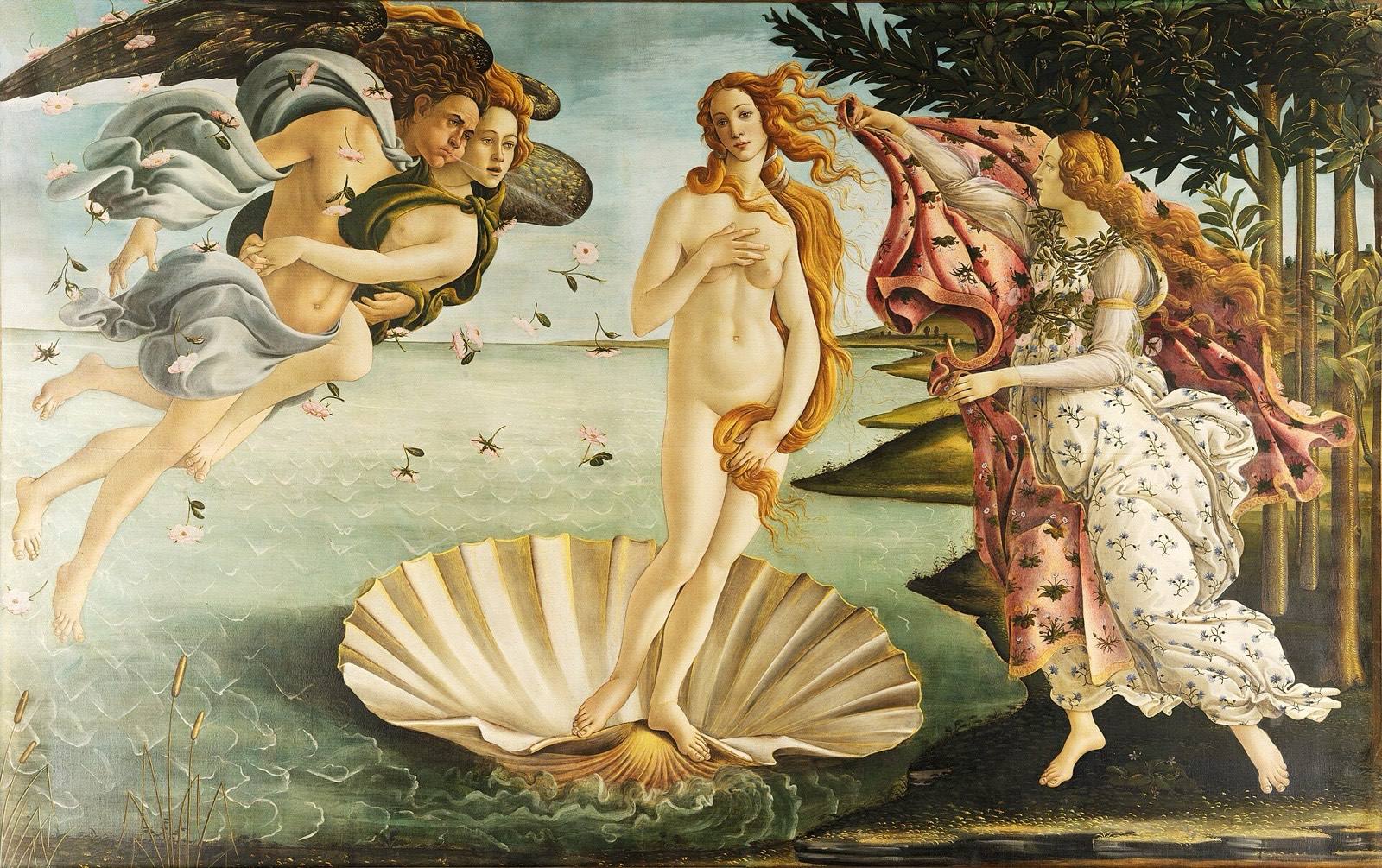
Despite its name, this shows the moment after her birth: born of the sea, Venus arrives at the shore on a giant shell, blown in by the wind god Zephyr.
 GajimaruClassics.
Preferences stay on this device. Reveal a painting without changing them.
Sandro Botticelli · 1485
painting
Select a detail to locate it.
Venus has reached the shore on a shell. Zephyr blows her towards a woman holding out a flowered cloak. Botticelli painted this arrival in tempera on canvas; the patron’s identity remains uncertain, and a connection with Poliziano’s poetry is possible.
The covering gesture recalls classical statues of Venus. Fine gold highlights run through her hair. Follow the movement from the wind at the left towards the waiting cloak at the right: the scene holds her between passage and arrival.
1485
Uffizi Gallery
Room 11-12, Botticelli's, Florence, Italy
Artist Sandro Botticelli Collection Uffizi Gallery, Florence
Despite its name, this shows the moment after her birth: born of the sea, Venus arrives at the shore on a giant shell, blown in by the wind god Zephyr.
A young woman, often identified as the Hora of Spring, hurries to meet her with a flowered cloak, roses tumbling in the wind around the pair who carried her.
Venus's modest pose recalls the classical Venus Pudica type. Botticelli picked out her hair, and much else in the picture, with fine strokes of gold.
Botticelli painted it in tempera on canvas rather than the wood panel of its companion the Primavera, its subject perhaps echoing the poet Poliziano's verse. Tradition long credited the Medici family, though who really commissioned it is uncertain.
By the first half of the 16th century the painting was kept at the Medici's Villa of Castello outside Florence. It hangs today in the Uffizi Gallery.
Sandro Botticelli paints Venus arriving at the shore, blown in by Zephyr, her subject perhaps drawn from the poet Agnolo Poliziano's verse.
It was long thought that a member of the Medici family commissioned the painting, though who really did remains uncertain.
By the first half of the 16th century, it hangs at the Medici's Villa of Castello outside Florence.
Today it hangs in the Uffizi Gallery in Florence.
A classical type of modestly posed goddess, shielding herself rather than standing openly bare. Botticelli based Venus's pose on this ancient model.