

GajimaruClassics.
Viewing preferencesShown as painted
Veil paintings showing

Preferences stay on this device. Reveal a painting without changing them.

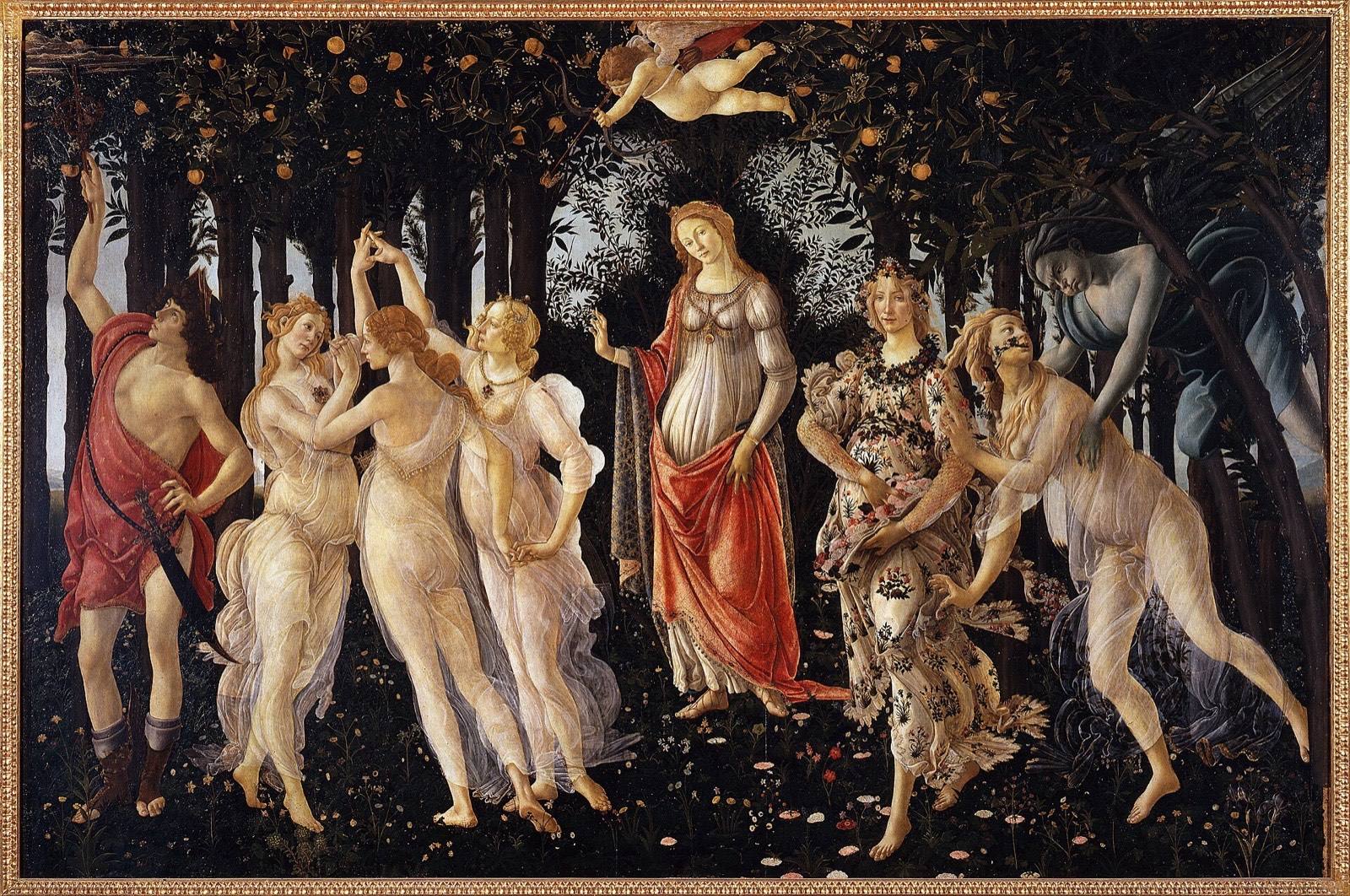
Primavera by Sandro Botticelli

Primavera

Sandro Botticelli · 1480s

painting

Look closer

Select a detail to locate it.

Nine mythological figures share Botticelli’s grove, but no single ancient story explains the gathering. Primavera is usually read as an allegory of spring; its precise meaning remains unsettled. By the end of the fifteenth century it belonged to a Medici household in Florence.

Details

Venus anchors the centre beneath a blindfolded Cupid. To her left the Graces join hands; to her right Zephyrus seizes Chloris, who becomes Flora. Follow Botticelli’s flowing outlines across these different encounters, keeping the violence of the seizure in view.

In its time

1480s

Paintings from this period
Where it hangs

Uffizi Gallery

In context

Nine figures, no single story

No ancient author tells this exact tale: Botticelli's nine gods and nymphs move through an orange grove that answers to no one myth. Most read the picture as an allegory of spring, a celebration of love, peace and abundance, rather than an illustration of any single story.

Pursuit and transformation

On the right, Zephyrus seizes Chloris, who is subsequently transformed into Flora, goddess of spring. Read the sequence as an act of coercion followed by transformation. Consider the narrative alongside the figures’ gestures.

A Medici household

By the end of the 15th century, Primavera hung in the Florence palace of Lorenzo di Pierfrancesco de' Medici, cousin of Lorenzo the Magnificent, a fact confirmed only in 1975 when a 1499 household inventory came to light. Large mythological panels like this one decorated the private rooms of Florence's grandest families.

Kept company with Venus

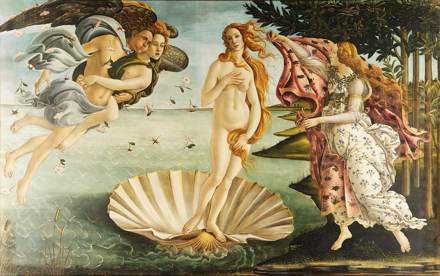
Giorgio Vasari saw Primavera at the Medici villa of Castello in 1550 and was the first to call it by its name, describing it alongside Botticelli's other great mythological panel, The Birth of Venus. The two still hang together in the Uffizi, though scholars know they were never designed as a matching pair.

Drawn like a dance

Botticelli cared less for solid, sculptural bodies than for line: his figures are slender, their limbs a touch too long, strung together by flowing hair and drapery. That rhythm, more than realism, is what gives the picture its grace.

The story

  1. Around 1480, Sandro Botticelli paints Primavera in tempera on a poplar panel.

  2. End of the 15th century: the panel hangs in the Florence palace of Lorenzo di Pierfrancesco de' Medici, cousin of Lorenzo the Magnificent.

  3. 1550: Giorgio Vasari sees the painting at the Medici villa of Castello and is the first to call it Primavera, pairing it with The Birth of Venus.

  4. 1919: Primavera enters the public collection of the Uffizi Gallery in Florence, where it still hangs.

  5. 1975: a household inventory dated 1499 resurfaces, confirming exactly where the painting first hung and reshaping how historians read its origins.

A way of seeing

Early Renaissance

Primavera belongs to Florence's Early Renaissance, when noble families filled their homes with large mythological paintings. Botticelli favours line over solid volume: slender, elongated figures linked by flowing hair and drapery rather than heavy modelling, giving the scene the rhythm of a dance.

More by Sandro Botticelli