
GajimaruClassics.
Viewing preferencesShown as painted
Veil paintings showing

Preferences stay on this device. Reveal a painting without changing them.

Ghent Altarpiece by Jan van Eyck

Ghent Altarpiece

Jan van Eyck · 1432

polyptych

Look closer

Select a detail to locate it.

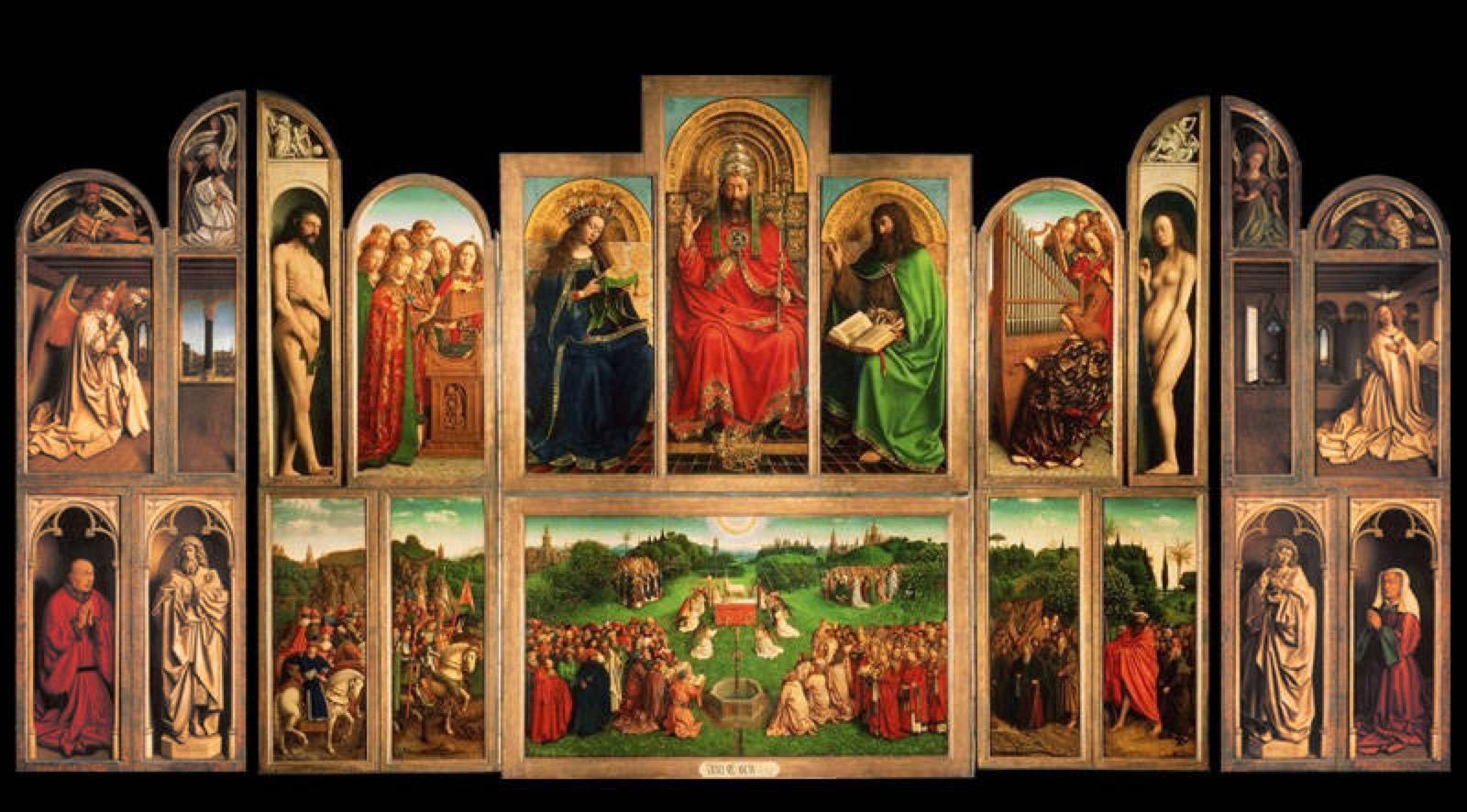
Completed in 1432 and credited to Hubert and Jan van Eyck, this altarpiece opens across hinged panels in St Bavo’s Cathedral, Ghent. At the upper centre sits a figure identified as Christ the King or God the Father, between Mary and John the Baptist.

Details

Compare the central group with Adam and Eve at the outer edges, nude and nearly life-sized. The separate panels hold these bodies within a larger folding structure. Opening or closing its wings changes what the viewer can see.

Where it hangs

St Bavo's Cathedral

In context

Two brothers, one mystery

The altarpiece is credited to two brothers, Hubert and Jan van Eyck, finished in 1432. Hubert, the elder, is a shadowy figure: almost nothing is known of him for certain, and no other painting can be confidently credited to him alone.

Berlin, then Versailles

Panels that left Ghent again later ended up in a royal collection in Berlin by 1821. After the First World War, the Treaty of Versailles brought the scattered panels back to Ghent.

Restoration in the open

A major conservation project backed by Getty Foundation grants began around 2010, and Belgium's Royal Institute for Cultural Heritage started a large-scale restoration campaign in 2012, work on one of the most renowned paintings in European history.

Closed face, open feast

The altarpiece is a polyptych, painted across separate hinged panels, so it has both a closed face and a fuller view when its wings swing open. It is also known as the Adoration of the Mystic Lamb, and elsewhere in Europe it goes by L'Agneau mystique in French or the Genter Altar in German.

The story

  1. 1432. The altarpiece is finished, credited to the brothers Hubert and Jan van Eyck.

  2. 1821. Panels that left Ghent again end up in a royal collection in Berlin.

  3. 1920. The Treaty of Versailles brings the scattered panels back to Ghent after the First World War.

  4. 2012. Belgium's Royal Institute for Cultural Heritage starts a large-scale restoration campaign, backed by Getty Foundation grants from 2010.

A way of seeing

Polyptych

A polyptych like this one is painted across separate hinged panels rather than a single canvas, so it can be shown closed or fully open.

More by Jan van Eyck