Two friends in London
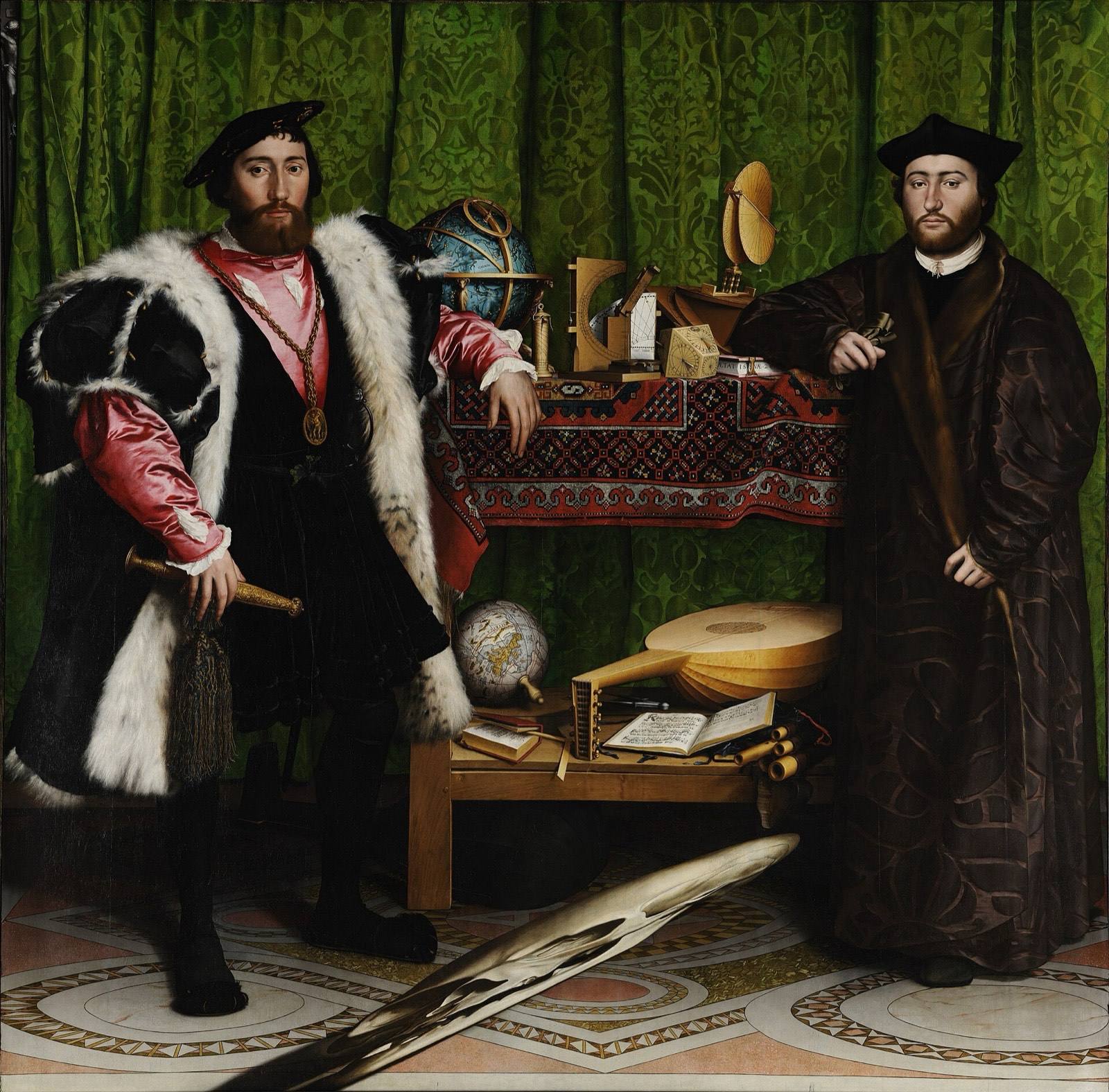
Jean de Dinteville, France’s ambassador to Henry VIII’s court, stands beside his friend Georges de Selve, Bishop of Lavaur. Their carefully rendered possessions occupy the space between them.
 GajimaruClassics.
Preferences stay on this device. Reveal a painting without changing them.
Hans Holbein the Younger · 1533
painting
Select a detail to locate it.
Holbein painted Jean de Dinteville, France’s ambassador to Henry VIII’s court, beside his friend Georges de Selve in 1533. Between them, instruments and books form a carefully rendered still life. The panel is just over two metres square.
Globes and dials measure the heavens; below them a lute has a broken string. Across the floor, a stretched shape becomes a skull from the correct angle. This reminder of mortality requires a different viewpoint from the portrait above it.
1533
National Gallery
Jean de Dinteville, France’s ambassador to Henry VIII’s court, stands beside his friend Georges de Selve, Bishop of Lavaur. Their carefully rendered possessions occupy the space between them.
Between the two men is a still life of carefully rendered objects. The top shelf alone holds instruments for measuring time and the stars, among them a polyhedral sundial, a many-sided dial with a face on each side.
On the lower shelf a lute lies with one string broken. Beside it, propped open, is a Lutheran hymn book, turned to the hymn 'Come Holy Ghost', in Latin Veni Sancte Spiritus.
The arithmetic book lies open at division. The terrestrial globe marks Polisy, where Dinteville had his château.
Stretched low across the marble floor is a distorted shape: seen from the correct angle it resolves into a human skull, a memento mori. Nearby, a small crucifix hides behind the curtain, top left.
1533. Hans Holbein the Younger paints Jean de Dinteville, France's ambassador in London, and his visiting friend Georges de Selve, Bishop of Lavaur, side by side.
Latin inscriptions hidden on a scabbard and a book quietly record their ages: Dinteville twenty-nine, Selve twenty-five.
Between them Holbein arranges a shelf of instruments for reading the heavens, and below it, books and a lute for reading the world.
A lute with one string broken lies on the shelf, and a Lutheran hymn book lies open beside it, turned to 'Come Holy Ghost'.
An arithmetic book, open at the page on division, and a terrestrial globe turned to Polisy quietly point to home, far from this room in London.
A small crucifix hides behind the curtain, and a distorted skull stretches across the floor between their feet: a memento mori for two learned men so far from home.
Anamorphosis is a trick of perspective: an image so stretched out of shape that it only becomes recognisable from one particular angle, like the skull hidden in the floor of this painting.