

GajimaruClassics.
Viewing preferencesShown as painted
Veil paintings showing

Preferences stay on this device. Reveal a painting without changing them.

The School of Athens by Raphael

The School of Athens

Raphael · 1512

fresco

Look closer

Select a detail to locate it.

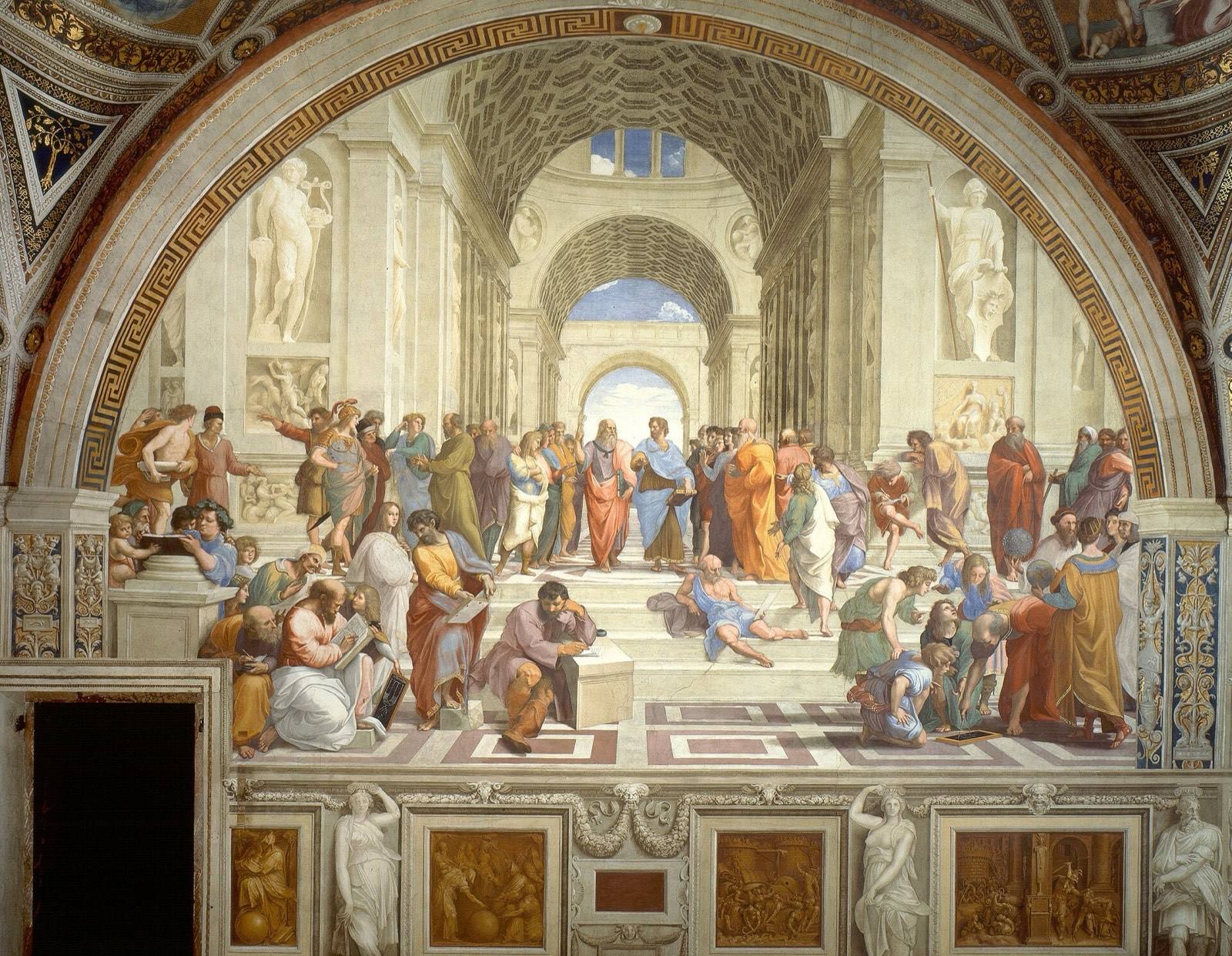
Raphael gathers ancient philosophers and mathematicians inside an imagined classical hall. Commissioned by Julius II for the Vatican’s Stanza della Segnatura, the fresco represents Philosophy within the room’s scheme of learning. Plato and Aristotle occupy its centre.

Details

The architecture draws the eye towards the two central thinkers. Pythagoras bends over a book in the foreground. Among the ancient company, art historians identify a likeness of Michelangelo; Raphael places his own face at the scene’s edge.

In its time

1512

Paintings from this period
Where it hangs

Apostolic Palace

In context

A room for four subjects

Pope Julius II set Raphael to fresco the Stanza della Segnatura, part of his private apartments in the Apostolic Palace. Four walls, four fields of learning: this one is Philosophy, facing the Dispute over the Sacrament's Theology across the room.

A hall Bramante might have built

Raphael set his philosophers inside an imaginary hall of vaulted ceilings and round arches, in the grand classical style Bramante was then using to rebuild St Peter's. Statues watch from niches in the background: Apollo on one side, Minerva on the other.

Borrowed from Leonardo

The knot of men leaning in to watch Pythagoras write is not entirely Raphael's own invention: the group strongly recalls the crowd in Leonardo da Vinci's Adoration of the Magi, which Raphael had studied during his years in Florence.

Michelangelo, borrowed for a day

The lone figure slumped in the foreground, dressed as a stonecutter and lost in thought, is read by art historians as Michelangelo: he was frescoing the Sistine Chapel ceiling a few rooms away while Raphael worked here.

The picture Raphael is remembered for

This fresco is regarded as one of Raphael's best-known works, the textbook example of High Renaissance ideals: unity, harmony, and the accurate perspective he learned from Leonardo. It was extensively copied for centuries after, prized for its innovative design and the virtuoso of its execution.

The story

  1. Pope Julius II calls Raphael to Rome and sets him to fresco a suite of rooms in the Apostolic Palace, the Stanze.

  2. In the Stanza della Segnatura, Raphael paints four walls for four kinds of knowledge. This one, facing the Dispute over the Sacrament, is Philosophy.

  3. He builds an imaginary hall of vaults and round arches, the grand style Bramante is using to rebuild St Peter's nearby, and fills it with the great minds of the ancient world.

  4. At its centre he places Plato and Aristotle, walking together exactly where all the hall's lines meet.

  5. In the foreground he paints Pythagoras bent over a book, a crowd leaning in to watch, a composition borrowed from a Leonardo da Vinci he had studied in Florence.

  6. Last, he paints in two faces from his own Rome: Michelangelo, at work on the Sistine ceiling nearby, as the brooding Heraclitus, and himself, in a black beret, at the scene's very edge.

A way of seeing

Vanishing point

Follow the floor tiles and the arches: every line rushes toward one spot, right between Plato and Aristotle. That is a vanishing point, the accurate perspective Renaissance painters used to make a flat wall feel like real, deep space.

More by Raphael