
Left on Naxos
In the myth, Ariadne has been abandoned on the island of Naxos by Theseus. The story comes from the classical poets Catullus and Ovid.
 GajimaruClassics.
Preferences stay on this device. Reveal a painting without changing them.
Titian · 1520s
paintingAbout 1.8 × 1.9 m
Select a detail to locate it.
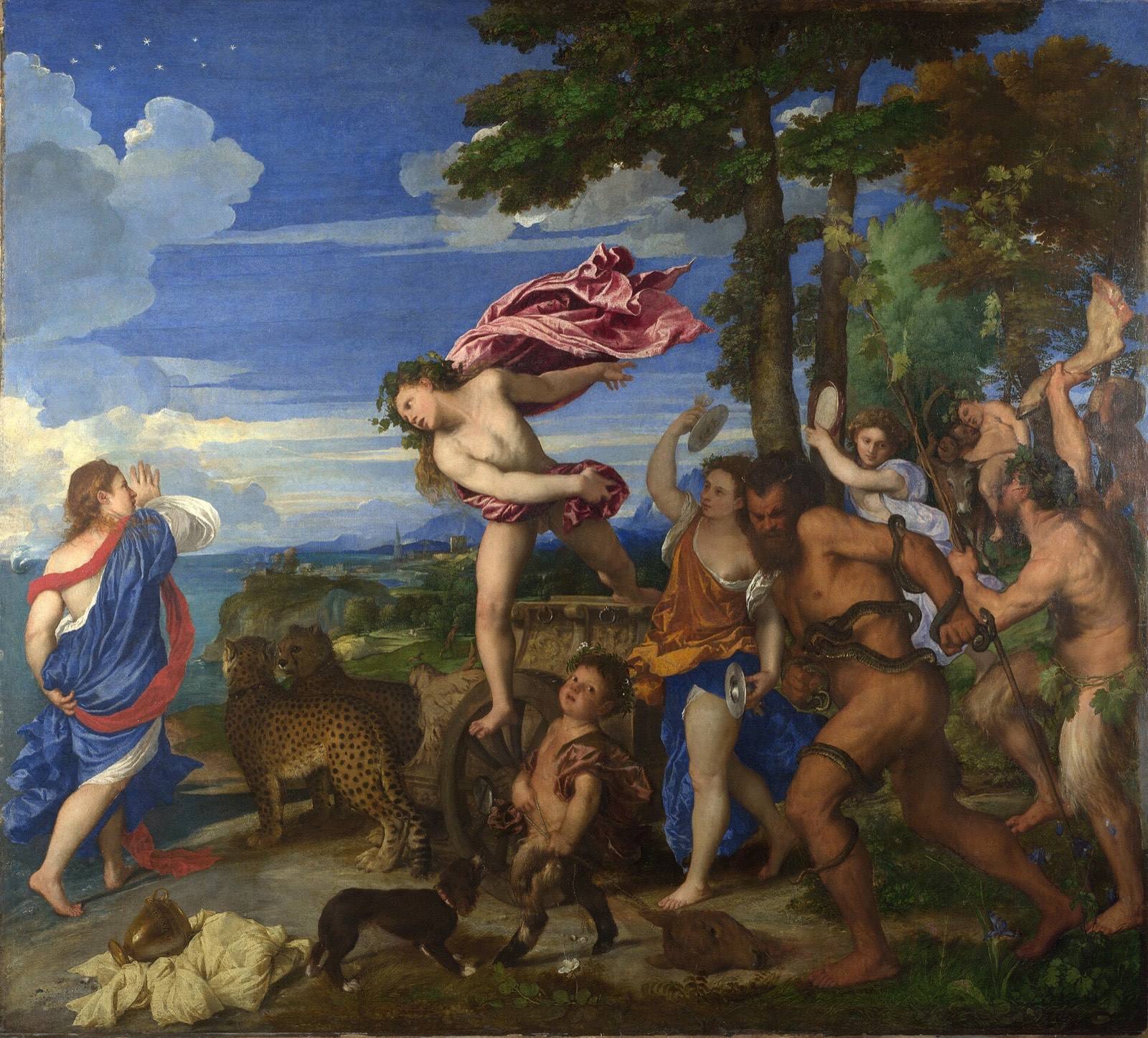
Ariadne, abandoned by Theseus on Naxos, encounters the god Bacchus. Titian painted the subject in the early 1520s for Alfonso I d’Este’s series of mythological pictures in Ferrara. It belongs to the National Gallery.
Find the crown of stars above Ariadne, then follow Bacchus and the followers accompanying him. Colour gives their encounter its force; compare the figures’ passages of colour across the canvas.
1520s
National Gallery
Artist Titian Date Early 1520s Collection National Gallery, London
In the myth, Ariadne has been abandoned on the island of Naxos by Theseus. The story comes from the classical poets Catullus and Ovid.
Above Ariadne is the constellation Corona Borealis, a crown of stars. The stars belong to a later moment in the myth, when she, or her crown, becomes the constellation, so Titian has already put that moment into the sky.
It was made for Alfonso I d'Este, Duke of Ferrara, for the Camerino d'Alabastro, or Alabaster Room. It is one of a series of mythological paintings made for that room. Titian also painted The Worship of Venus and The Bacchanal of the Andrians for the same series, and both are now in the Prado.
The story Titian paints comes from the classical poets Catullus and Ovid.
1520s. Titian paints Bacchus and Ariadne for Alfonso I d'Este, Duke of Ferrara, as one of a series of mythological paintings for the Camerino d'Alabastro.
Today. It hangs in the National Gallery, London, and is highly regarded.
A painter can show a later moment of a story inside an earlier one. Here Ariadne has been abandoned on Naxos, yet the crown of stars that comes later in the myth is already above her.